Note

All stories posted in this blog have been published previously in The Star, Malaysia.

Monday, November 27, 2006

The truth about freemasonry


HARRY Houdini was there, peering out from his portrait at the hallowed corridor on the 12th floor of the Masonic Hall in New York.

That the legendary magician was one of the many distinguished members of the American freemasonry surely added mystery to what has often been seen as the oldest secret society in the world.

The reality, however, is that the freemasons are more open and less sexy.

Their awesome headquarters here is available free for public viewing six days a week, a little known fact as the reputation of this two centuries-old organisation precedes itself.

“We often hear that membership is based on invitation. That's not true at all,” said Thomas M. Savini, the Masonic Library director.

The truth is that it remains a deeply ritualistic, male-only fraternity and one that is slowly graying but the members are not deterred from performing the many community services they so cherish.

As the sprightly 80-year-old Anton J. Kurz said proudly: “We have 22 hospitals throughout the United States, offering free treatment to the poor whether they are freemasons or not.

“We are not a political, religious or military organisation. We are a charitable organisation which gives out millions of dollars everywhere,” he said.

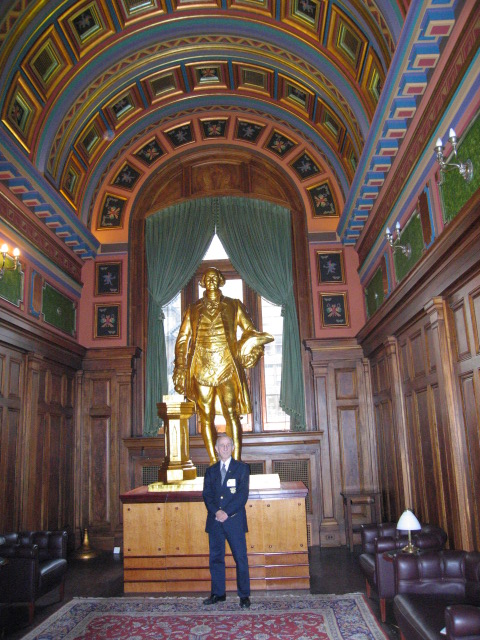
Kurz, who is a member of the tour committee, guides visitors to selected rooms in the 19-storey Masonic Hall, which was built in 1910.

Each room or lodge, where freemasons hold their meetings, is quite similar in layout with their imposing columns, grand chandeliers, Masonic symbols, altar and an electronic organ.

The difference lies in the theme of the designs.

For instance, the Empire Room features 19th century French motifs, the Chapter Room an Egyptian theme and the Jacobean Room a medieval setting.

“Houdini used to come to the Empire Room,” said the Prague-born Kurz, a freemason for four decades.

Outside the Jacobean Room, there was a notice put up about a blood donation drive to be held on Dec 1.

The Grand Lodge Room has an intriguing trivia. Its architect was H.P. Knowles, who later designed a similar hall for the Titanic. He died on that ship when it sank in 1912.

Indeed, the freemasons are steeped in tradition although the origin of the organisation remains vague.

When George Washington was sworn in as the first US president, the “Masonic Bible” was used.

According to library director Savini, it was also supposed to have been used during the swearing-in of George Bush senior. However, it rained that day and the plan was abandoned because they did not want to risk damaging that rare book.

President George Washington was a freemason and a replica of a famous statue of him now stands at the Hollender Room where ancient books line both sides of this private office and the ceiling features Mayan and Inca themes.

“This is where the Grand Master of Masons and his committees would have their meetings to decide on new laws or any changes to be made,” said Kurz.

There are about 56,000 freemasons in New York state; a far cry from the early years when membership was at the 300,000 mark.

Still, New York has one of the biggest memberships in the United States. Its library here, which has 60,000 books on Masonic philosophy, is the largest of its kind in the world.

Its website (www.nymasons.org) lists famous members such as movie director Cecil B. DeMille, astronaut Edwin E. Aldrin, car maker Henry Ford and Benjamin Franklin, who had a hand in drafting the US Constitution.

But with a declining membership and visitors averaging about 60 each week, it appears that the freemasons will remain an enigma to people who love looking for a good mystery.

(Sunday November 26, 2006)

Gay men and shattered lives

FOR women like Dina Matos and Gayle Haggard, their story is seldom told.

Matos has kept a stoic silence since her husband, a former New Jersey governor, emerged from the closet two years ago. They are separated now.

Haggard wrote a letter to her church members two weeks ago stating that she loved her husband dearly “till death do us part”.

She is married to the Rev Ted Haggard who recently resigned as president of the National Association of Evangelicals and pastor of a 14,000-member church in Colorado after he admitted to “sexual immorality” following accusations from a male escort that the reverend had paid him for sex. He denied the charge but admitted that he had a massage from him.

“For those of you who have been concerned that my marriage was so perfect I could not possibly relate to women who are facing great difficulties, I know that this will never again be the case,” said the preacher’s wife, her heart broken.

Bonnie Kaye, 55, has lived through such pains as well.

“He loved me but not in the way a man should love his wife,” said Kaye of her former husband. They were married for eight years and have two children.

In a telephone conversation from Philadelphia where she lives, Kaye said her husband never admitted to his homosexuality throughout their marriage.

She spoke of her earlier suspicions, such as the way her husband would look at a certain guy and how he became overly excited about being with his male friends but never displayed similar fervour when she was around.

“It ended up an unhappy marriage. He tried to live a life that was not his.”

When he eventually opened up to her years after their divorce, Kaye said there was not much emotion “because I already knew it by then”.

Since 1984 when her marriage ended, Kaye has earned a master’s in counselling and has been helping women in the same shoes.

“About 95% of the women have no clue about their husband. These men usually get married in their 20s. They are young and they can respond to any touches. So, there is no way for the wife to tell because the husband can still perform sexually for a number of years,” she explained.

There was also the stereotype behaviour of gays as portrayed on TV when, in reality, not all of them would exhibit such attitudes, she said.

“Studies have shown that most men refuse to tell the truth to their wives. Ask them about it and they will tell you that you’re crazy,” she said.

Afraid of losing their family and respectability, they did not want to get out of the marriage.

“The gay movement hasn’t come that far,” said Kaye, who has written four books on the subject. Her latest, Straight Wives: Shattered Lives, which came out in September, is a compilation of the testimonies of 27 women from around the world.

She said such marriages often lead to the wives suffering from low self-esteem. Some of them went for treatments such as liposuction, thinking that they could make themselves attractive to their husband again.

“I have worked with two models and women who have doctorates, all of whom are suffering from low self-esteem. It is a trauma, a very horrible experience for women to go through.”

Many of the wives were in despair and afraid of being blamed, for instance by the in-laws who would say “What did you do to him? My son was okay when he married you.”

Thus, Kaye’s next book will be called How I Made My Husband Gay. It’s a sarcastic title, said Kaye, who believes that being gay was “determined at birth”.

Besides being featured on TV and appearing on talk shows, Kaye also manages two websites on the topic.

“I used to feel that I’m the only one in this. In the 1980s, this was really a taboo but it is getting more common now, especially in the last two years,” she said.

She wants to send out the message to women in a similar predicament that there is help and support when they need it.

As for her former spouse, Kaye said she has already forgiven him.

“He wasn’t a good husband but he is a very good ex-husband,” she said, laughing.

(Sunday November 19, 2006)

1,001 election tales – and still counting

IT’S time to check out those little election footnotes, now that the major headlines have captured attention everywhere.

A huge production like the US mid-term election would spawn 1,001 tales and Tuesday’s polling was no exception.

New York’s cosmopolitan nature means that notices put up at the polling stations had to be written in several languages like Spanish, Mandarin and Japanese, besides English.

Interpreters were available for those who can’t read English and do not know how to operate the voting machines.

“Some of them even asked me whether they should go for the donkey or the elephant,” said Moses Loo, a Chinese interpreter. These animals are the symbols respectively of the Democrats and the Grand Old Party.

Loo acknowledged cheekily that he was tempted at times to influence them.

“One woman asked me who she should pick for the New York comptroller post. I told her not to vote for Alan Hevesi,” he said, referring to the Democratic contender who made use of a state employee to be his wife’s chauffeur for three years.

“But the woman was smart, too. In the end, she did not vote anyone for that post.”

For the record, Hevesi survived his political scandal and was re-elected for a second term.

Loo observed that voters had their own peculiarity. “Some of them would pick the same party for all the posts without knowing the candidates. They would just vote blindly.”

(Besides major positions like the senator and governor, the mid-term election sees a long list of posts such as judges, and state and local officials being contested.)

News reports on Wednesday showed that Murphy’s Law was in full swing on polling day, affecting even 26-year-old Chelsea whose parents are the very important Clintons.

The former first daughter could not find her name in a Manhattan polling station because the list had been sent elsewhere.

At one Bronx polling station, the cops had to be called in to break into the building when no one knew why the place was still not open at 6am as scheduled.

Countless people complained to the blogs about hitches and mismatches. One site experienced such high traffic volume that it had to make certain restrictions.

A Tennessee guy wrote: “I went to my precinct to vote and all the three machines were not working. You would think they would have at least been tested before the actual election day.”

(When George W. Bush announced the resignation of Defence Secretary Donald Rumsfeld, someone blogged: “Right now I think I’d rather you keep Mr Rumsfeld and replace yourself with Mr Cheney.”)

Bloggers had their night out when CNN hosted 25 of them for an “E-lection Nite Blog Party”. This was something new, according to Andrew Tyndall who issues an online weekly report that tracks night-time news coverage on ABC, NBC and CBS.

“In five years, the news will be presented online,” he predicted.

As for the election TV coverage, Tyndall picked ABC anchor Charles Gibson for doing a great job.

“He clearly knows a lot. I thought he was the best and most informed,” he said, adding that Gibson’s background as a congressional correspondent was obviously an advantage.

TV stations had been cautious this time to avoid a repeat of the blunder made two years ago when exit polls showed John Kerry was the likely presidential winner. The final outcome showed otherwise.

While this has been described as the nastiest mid-term election in US history, things were pretty calm in New York where it was clear that the Democrats had the upper hand.

Eliot Spitzer, who won the governor’s post, was so assured of his victory earlier that he did what the New York Times said was unheard of: he stopped campaigning in the final 24 hours before the race.

Since this had been a political blood sport, a tabloid helpfully guided its readers on where to find pubs that indulged in their political affiliation.

One bar owner was quoted as saying: “Democrats are more likely to drink single-malt whiskey and bourbon. Republicans like blended scotch.”

And the best drink for voters to drown their sorrow is Jack Daniel’s, apparently.

The following day, America’s top two tabloids did not neglect their pop princess amidst the big front-page news about the Democrat sweep.

So, appearing also on page one of the New York Post and Daily News was news about “Splitney Spears” seeking a divorce from her husband.

(Sunday November 12, 2006)

Saturday, November 25, 2006

Return of the domestic goddess


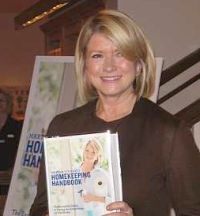
MARTHA Stewart the domestic diva appears to be reigning still in the hearts and homes of American women.

Her latest book titled Martha Stewart’s Homekeeping Handbook came out on Tuesday, an encyclopaedia of tips from “how to fold a fitted bedsheet” to the different types of mops in the market.

In another chapter of America’s “comeback kid” stories, the lifestyle guru has gradually bounced back after her release last year from a five-month imprisonment for insider trading.

Stewart appeared on Wednesday at Williams-Sonoma, a swanky home furnishing store in Manhattan’s Upper West Side, to sign copies of her US$45 book, which would have an initial print of 500,000.

Prior to her arrival, the handful of press members (mostly photographers) were given strict instructions that there would be no interviews and that photographs were permitted for only five minutes. They must then vacate the media area at once.

Within 10 minutes after the briefing, another staff member came up to the press to repeat the list of don’ts, besides saying which door she would emerge from.

Stewart was a picture of grace when she arrived. At 65, she looked younger than her age.

In a mini-speech, she said the book took her years to complete and that she was grateful to those who turned up for the book-signing.

“I am very excited to be here,” she said.

Those who wanted her signature were earlier given strict instructions, too. Each buyer was limited to three copies, no photographs allowed and that due to limited time, Stewart would just sign her book without personalising it. No “Dear Jane” sort of thing.

That did not put off her admirers. They loved her creativity, describing her as an inspiration and that she had come back stronger than before.

Many of those who turned up bought the maximum three copies allowed. “One book is for myself, the other two are gifts,” said teacher Donna Noone, whose husband was next to her, carrying the three copies of the 752-page book.

For accounts manager Melissa Ingeam, Stewart was her idol whose household tips she often followed.

“I always light a candle when I peel onions to prevent teary eyes, as suggested by Martha. It works!” she said.

The following day, Stewart appeared on Today, NBC’s top-rated morning news show, demonstrating ways to remove wax from the table cloth and how to get rid of stains.

Stewart also promoted the book on The Martha Stewart Show, telling TV viewers that she had been inspired by a 19th century guide titled “Mrs Beeton – Book of Household Management” that was given to her as a wedding gift in 1961.

Studio audience that day were each given a copy of her book.

“There are six things to do every day,” she said. Make the bed, manage clutter, sort the mail, clean as you cook, wipe up spills and sweep the kitchen floor.

Her weekday syndicated show, incidentally, will be going for the third season as major TV stations have just announced that they are picking it up again.

The earlier failure of The Apprentice: Martha Stewart seems far behind now.

On her show, Stewart shares her recipes from simple ones like how to make an egg-white omelette to the more complicated poached pears.

Celebrities such as Cynthia Nixon and Barry Manilow have been guest stars in the past week.

The Martha Stewart Show is pitted against another daytime show by Rachael Ray, a popular TV personality, which is aired at the same time.

Ray, who found fame with her 30-minute meals, is reportedly attracting higher TV ratings.

But still, the more staid-looking Stewart seems to be holding up well against her perky, younger rival who is just 38 years old.

The older guru has a radio show as well, besides magazines and a myriad of products.

Opinion polls carried out much earlier showed that Americans believed Stewart would pick herself up again.

To these people, it’s the return of the domestic goddess.

(Sunday November 5, 2006)

Reds singing the blues

IT was no cosmic coincidence that country music ruled in the “red states” that went for George W. Bush in the 2004 election.

Statistics show that there were 1,580 country music radio stations in those 31 states that favoured the current US president. The other 20 “blue states” that John Kerry won in had a mere one-third of such radio stations.

How is this a barometer of Americans’ voting pattern?

According to David J. Firestein, an American career diplomat who has taught political campaigns and communication, country music is mostly about family, religious devotion and patriotism.

“It’s an identity that talks about old-fashioned values, things that ‘my dad taught me’,” he said.

Bush, he said, knew this very well and so his use of symbols like cowboy boots and a Texas swagger partly helped him “ride all the way to a second term”.

He noted that Bush picked a rousing country tune, Only in America by Brooks and Dunn, as the official campaign theme in 2004.

“Only in America/Where we dream in red, white and blue/Where we dream as big as we want to...”

Firestein, who gave a talk titled “Mid-term Election: What Factors May Sway Voters?” at the New York Foreign Press Centre recently, said political campaigns were mostly about identity and not issues.

“What kind of a country is America? Will this person represent the values that I stand for? It’s all about identity,” he said, giving examples of the sort of questions that weighed in on the mind of voters.

He said that about 50 million Americans tune in to country music for about three hours daily, listening to songs that dealt with religion, the Bible, angels and so forth.

“The average country music fan is white, female and probably in her 40s, married with kids.”

And it is the kind of songs that they do not mind their kids hearing over the radio.

Firestein found that about 20% of the top 50 country hits each year touched on the traditional family bond.

Such music may indulge Americans’ yearning for the good days, but it is clear that it is no longer a simple life now.

Questions of morals and ethics confront a number of election candidates as scandals emerged, scarring the name of their good office in recent weeks.

Jeanine Pirro, the Republican candidate who is eyeing the post of New York state attorney general, is under investigation for allegedly planning to plant a bug inside the boat of her cheating husband.

She defended herself, saying that she did not secretly tape her husband’s conversations although she had thought about doing it. (Wiretapping a spouse is unacceptable in court as it is a violation of ethics. But the law does not cover photos or videos, so cameras are okay to trap the errant spouse, apparently.)

Her husband has been bad news for her political career. He reportedly had affairs, besides fathering a child with another woman, which he denied until a paternity test proved it in 1998.

In 2000, he was convicted of tax evasion and spent 11 months in jail.

“Albert J. Pirro Jr (Jeanine’s husband) makes Bill Clinton look like a saint,” a reader of The New York Post said.

On his part, Albert described himself as a lonely political husband who wasn’t getting enough attention at home.

Another scandal confronting the Republican Party is the resignation of Mark Foley, who quit the Congress last month after news broke that he indulged in sexually-explicit online chat with teenage boys.

A probe is now going on to find out whether appropriate action had been taken to stop Foley earlier, since several lawmakers and top Republican aides had apparently known of his bad behaviour before it became public knowledge.

New York state comptroller Alan Hevesi of the Democratic Party is in the soup, too. He had made use of a state employee to serve as a personal chauffeur for his ailing wife for three years.

Such stories must surely lead to fans of country music singing the blues now.

(Sunday October 29, 2006)

Tuesday, November 21, 2006

Little India in the Big Apple


THE pulsating beat of a Hindi song pumped out from a record store plainly named Bollywood Music.

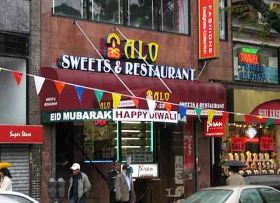
Nearby, its neighbours hawk just about anything from saris to vegetarian samosas. There’s Bombay Boutique, Mita Jewellers, Indian Taj Restaurant and Delhi Palace Sweets, just to name a few.

“The place makes you forget momentarily that you are in New York,” said S. Ganeson, a counsellor at the Permanent Mission of Malaysia to the United Nations.

That’s Little India, located in Jackson Heights, Queens, on a short strip of 74th Street, which is also known as Kalpana Chawla Way.

(Chawla was the India-born American female astronaut who died at the age of 42 along with six other crew members in the explosion of the space shuttle Columbia three years ago.)

Most of the people here speak English with their distinct Indian accent.

A month ago, Little India was all stirred up over lentils. The price of the small seeds had hit big time, with one pound of white lentils, for example, almost doubling to US$1 from 65 cents.

Prices shot up when India, the biggest exporter of lentils, decided to impose a ban on exports following a drought that led to reduced yields.

“The price is still high,” one restaurant owner said.

Little India is home to the biggest number of South Asian immigrants in New York.

A pretty young woman attending to customers at Delhi Palace Sweets said she was a Muslim from Bangladesh.

Her small shop sells a large variety of pastries and desserts such as jilebi (made of flour, yoghurt and ghee) and samosa chaat, made of potato and cumin seeds. They were priced at US$4 per pound.

According to Ganeson, Little India of New York is a lively place where you can find fresh food products and spices from the sub-continent.

“However, it is not so similar to what we have in Malaysia because we are more towards southern India,” he explained.

The Indians here remain steadfast in celebrating Deepavali although they acknowledge that it could never be on the grand scale that it is in their homeland.

“We used to play firecrackers back in India,” said Surinder Pal, as he reminisced of his days in Punjab.

Married with four children aged between eight and 23, he said his family still maintain practices like putting on new clothes and jewellery for the Festival of Lights. “We pray and light the lamps.”

Surinder, who came to the United States in 1979, runs a fabric shop here. His saris are priced from US$20 to US$200.

Restaurant employee Ravi Verma said he had already bought new shirts and shoes. Prayers are a must, too, he said, gesturing to the altars of Ganesha and Lakshmi inside the restaurant.

“There is also a big temple here that I go to,” said Ravi, 36, who came from New Delhi. New York has been home to him for almost 10 years.

Here in Jackson Heights, Little India seems like a flourishing place, especially during the days leading to Deepavali.

(Sunday October 22, 2006)

Taking the 3Rs seriously

THE noise inside the subway train did not bother him at all. His attention remained fixed on his book.

No more than 12 years old, he was reading from one of the “Artemis Fowl” series of children’s book about a young, ingenious criminal mastermind. The series has become an international bestseller.

There is something gratifying in seeing a young boy so engrossed in his reading. The bespectacled chap was probably a bookworm.

On another occasion, a Hispanic boy was also completely absorbed in his science fiction tale while riding on the train with his mother.

It appears that American society is much more into reading than Malaysians.

One indicator is the subway train where commuters do not just pore into magazines and newspapers but also books. Sometimes they read while standing inside a crowded train.

Then, there is the ubiquitous Barnes & Noble bookstore. It is a cosy place where people would not mind you reading there for hours.

“And if you order a book from them before 11am, they can deliver it to you on the same day. That’s what I like about this bookstore,” said H. de Pinho, an academic from South Africa.

Such a service was unavailable in her home country, she said.

Apparently, Barnes & Noble has at least one million titles for immediate delivery.

There is also the Strand Book Store, which boasts of 18 miles of books and sells its titles at about 20% lower than the list price. For instance, Breakfast At Tiffany’s is sold at US$9.71 instead of the list price of US$12.95.

Barnes & Noble also has all sorts of benefits and discounts for its members.

Book reviews appear almost daily in every other newspaper here. The New York Times, in fact, publishes a 30-odd page-pullout every Sunday just on book reviews.

Print advertisements of a new title frequently take up a whole page in the broadsheet New York Times.

For example, A Spot of Bother, the new novel by Mark Haddon (author of The Curious Incident Of The Dog In The Night-time) was promoted in a full-page advertisement. So was Mitch Albom’s For One More Day, which came with the enticing question: “What would you do for one more day with the person you loved the most?”

Ann Caggiano, a marketing executive, cautioned, however, that such heavy publicity was possible because of the huge financial machine.

The intense promotion was probably a factor in fuelling the reading public, she said.

“My impression is that people who live in bigger cities tend to read more. There is the ability to receive more information at all times, besides a bigger need to expand their horizon,” she said.

Caggiano was among those who attended a book discussion by Amy Tan two weeks ago at a Barnes & Noble bookstore. The author was promoting her latest book, Saving Fish From Drowning.

Those who attended swamped her with questions: How was she inspired to write the characters? Why such a title?

Earlier, Tan told her audience that she would revise her copy about 100 times and that what she wrote in the beginning would become very different at the end of the day.

“It is a painful process,” she said.

Such book readings and discussions are so common here that you can find one almost every other day.

Then there is the impressive New York public library, which has 85 branches in Manhattan, the Bronx and Staten Island. The borrowed item can be returned to any of the branches in these boroughs. Membership is free.

These libraries offer a wide range of materials, from books to videos and so forth. Magazines are not restricted to serious titles only. You can find anything from Time magazine to Cosmopolitan.

Today, one New York park will host an event billed as the “Great Read in the Park”, where established writers and budding authors meet the public and conduct panel discussions and book signings. There’s even a children’s stage.

For New Yorkers, it is indeed the 3Rs – read, read and read.

(Sunday October 15, 2006)